|
|
|
 |
 |
|
How to identify your Crane faucet/fixture As with many manufacturers, Crane made many changes over the years, but there are two significant periods of manufacturing, pre WW2 and post WW2.
|
|
|
 |
 |
|
The easiest way to tell is the date. Most Crane sinks have the date of manufacture cast into or embossed into the fixture.
Usually there is a Star shaped logo printed on the fixture that will also mention the Model of the sink. The model name can be extremely
helpful! Once you’ve determined the date of manufacture, look at the appropriate section to find the part you need. We’ve not been able to
find any Crane sinks that were manufactured between 1942-1946, so we consider that to be the War years. Anything before 1942 is pre-war, anything after 1948
is postwar.
|
|
|
|
 |
 |
|
Another easy way to tell the vintage of your Crane valve is this. Prewar valves have cross handles like the
picture on the left. Postwar valves have handles like the one pictured on the right.
|
|
|
 |
 |
|
One of the joys of deciphering your Crane sink’s vintage is the fact that Crane used model names for many years. Many model names such
as Drexel, Diana, Oxford, and others span both the prewar and postwar years. This is where the handle design will come into play.
|
 |
 |
|
Prewar Crane Valves
|
 |
 |
|
Prewar Crane valves came in many shapes and styles of trims, but all of the stems used were of a compression type. This means they all have
good old rubber washers and seats inside the valves that actually do the work. .
|
 |
 |
|
Prewar Crane Widespread lavatory valves
|
 |
 |
|
There are three common versions of prewar widespread valves and they all take different stems. An easy way to tell which one you have is to measure the length
of your stem. Click here to be taken to the Crane stems ordering page.
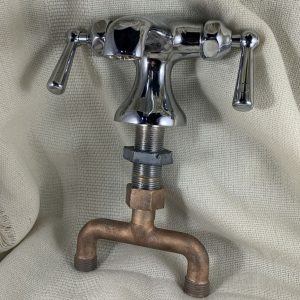
If you have the valve body pictured at right, with either metal or porcelain handles and escutcheons, and your sink is a Elegia, Nova,
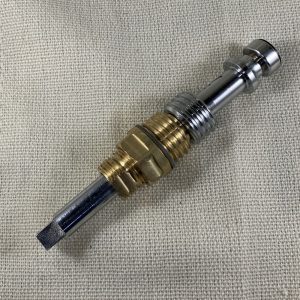
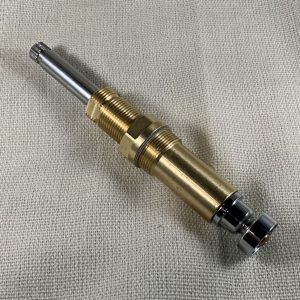
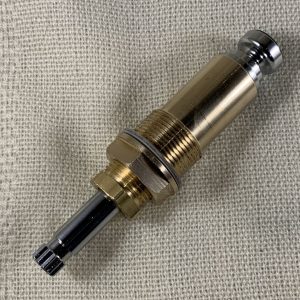
Ovation, Corwith, or others that have a stem that is 5 3/4” long, your valve takes our #86-101HC or our 86-121HC Crane stem.
|
|
|
|
|
 |
 |
|
If you have the valve body pictured at left, and your sink is a Norwich, Compeer, or others that have a stem length of 4 1/2” you
need our Crane stem # 86-041HC.
There is a Pre WW2 Crane Drexel sink that
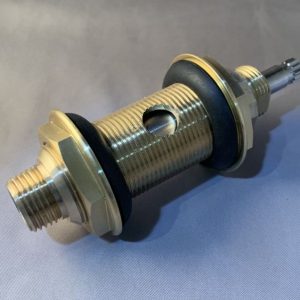
uses a very similar trim, but the valve body will look different. This valve body uses rubber washers that seal the faucet to the sink. They are always
mounted on a 45 degree slant. Two different stems were used, either the 86-041HC or the 86-211HC. If your escutcheon is held on by a escutcheon nut
like the picture at left, you’ll need the 86-041HC stem. If the escutcheon screws directly onto the stem, you’ll need the 86-211HC stem.
|
|
 |
 |
|
Crane 6” Centerset Lavatory valves These valves were used on Norwich, Sterling, Ipswich, and other sinks. They can be identified by the unusual 6” dimension from
handle screw to handle screw. Early versions used a square ended stem and can be special ordered. The later versions have a 12 point spline and use our Crane stem
# 86-071 and 86-072 stems.
The 071 is for the hot side and the 072 is for the cold side.
|
|
|
 |
 |
|
We do have a limited supply of original prewar valve bodies available if yours is beyond help. Call
for details! 1-800-255-4426
|
 |
 |
|
Postwar Crane Valves
|
 |
 |
|
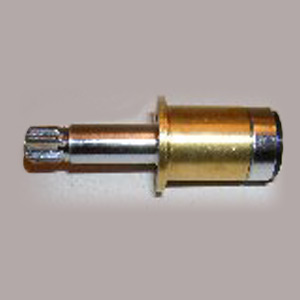
After WW2 ended, Crane again began manufacturing valves and sinks. They reworked their entire line to use only one stem design. They
called it the Dial-eze, and it was used in practically all Crane valves made after 1948 until Crane
was sold in the early 1970’s . There are several different trims, but all use the same stem. There are some differences in sink design, and we’ll
review them below.
|
 |
 |
|
Crane Intregal spout Dial-eze Lavatory.
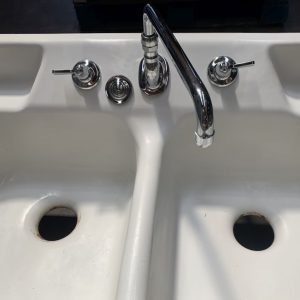
The postwar Crane Drexel and Marcia sinks are of an integral spout design. Both take the Dial-eze stem. The sink pictured at right is a Marcia version, the Drexel is subtly different, but both have the faucets mounted on a 45 degree slant and takes our #86-600 flange, 15-VBS sealing washer, and 79-266C handle.
|
|
|
|
|
 |
 |
|
Crane Metal spout Dial-eze Lavatory Many Crane postwar sinks used this design, they include Diana, Elayne, Westland, Countess, Norwich, and others. They all still
take the Dial-eze stem . Replacement parts are as follows; handles are #79-266C, trim rings are 86-650, and replacement locknuts are 86-550 The pictured sink is a Diana, this design is used for both free-standing, and countertop mount
sinks.
|
|
 |
 |
|
Crane Criterion Widespread Lavatory
During the ‘late 1950’s, Crane updated their line with the new Criterion valve set, it featured trendy clear lucite handles, and a brushed chrome
finish. It still used the Dial-eze stem and some parts are still available.
One can still get the lucite handle ring, #20-24463, and the trim ring, #86-650. If the handle is stripped, you can replace the entire handle with our #80-1123.
|
|
|
 |
 |
|
Crane Lavatory sink Index
|
 |
 |
|
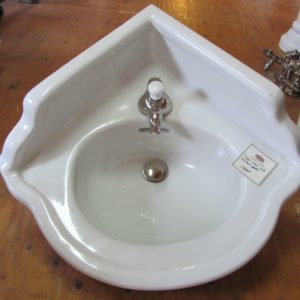
Crane “Cornate” - 1948 to 1970. Corner wall hung sink. Uses same faucet as Oxford. 90-201H and 90-201C Dial-eze cartridges. Drain assembly is unique. Crane “
Coronet” - 1937-1942 Widespread integral spout, always mounted on a metal cabinet. Takes our 86-041HC stem, 15-51005 handles, few other parts available. Crane “
Corwith” - around 1930 to 1942 Multiple varieties of configurations, including widespread, 4” center, separate hot-cold taps, Multiple stem varieties,
some trim parts available. Crane “Criterion” - 1948 to 1970. Dial-Eze stems only. Top of the line in it’s day. Most parts
available, exception would be the spouts. Could be tile-in, countertop, console, or cabinet mount. Crane “Diana” - late 1930’s to 1970.
Two different periods of valve design. Everything before 1948 used the 86-041HC stem, 1948 and after used the Dial-eze stem. Most postwar parts are available, pre-war parts have limited availability, just handles and stems. Crane “
Drexel” - 1938 to 1970. Two different periods of valve design. Everything before 1948 used the 86-041HC stem, 1948 and after used the Dial-eze stem. Most postwar parts are available, pre-war parts have limited availability, just handles and stems. Crane “
Elayne” - 1948 to 1970. Countertop mount verion of the post WW2 Diana. Tile-in or Hudee ring. 90-201H Dial-eze cartridges. Most parts available. Crane “Elegia
” - Ballpark dates of manufacture from around 1920 until 1938. Uses our # 86-101HC or 86-121HC stems, depending upon the handle design. Early stems were square on top, later ones are 12 point splined. Reproduction Handles and escutcheons available here. Crane “Idalia” 1920 to early 1930’s. Pegleg, multiple faucet designs.
Limited parts availability. Crane “Marcia” - 1948 to 1970. Countertop mount, either tile-in or Hudee ring. Most parts available, uses
dial-eze cartriges. Ceramic spout. Crane “Neuday” - Mid ‘30’s to mid-’60’s. Two different periods of valve
design. Everything before 1948 used the 86-041H and 86-042C stems, 1948 and after used the 90-201H Dial-eze cartridge. Most postwar parts are available, pre-war parts have limited availability, just stems. Unique drain assembly. Crane “
Neuvogue” - 1930’s. Top of the line in it’s day. No parts commercially available, stems can be made, stem is extremely complicated.
Distinguished by handles going into side through porcelain, very little metal trim visible. Crane “Norwich” - 1930’s to 1970. Many, many
different varieties of faucets were found on this sink. Refer to stem guide to find yours. Crane “Nova
” - late teens up to the early 1930’s. Uses our # 86-101HC or 86-121HC stems, depending upon the handle design. Early stems were square on top, later ones are 12 point splined. Reproduction Handles and escutcheons available here. Crane “Ovatus” - late teens up to the early 1930’s. Uses our # 86-101HC or 86-121HC stems, depending upon the handle design. Early stems were square on top, later ones are 12 point splined. Reproduction Handles and escutcheons available here. Lever handle faucets did exist, stems can be special ordered in some cases. Crane “Oxford” -
1948 to 1970. China wall hung sink, 4” faucets mounted on a 45 degree slant. Some parts available, limited supply of restored faucets available as well.
unique drain assembly. Rare version has oversize single hole in sink with a metal plate under faucet. 90-201H and 90-201C Dial-eze cartridges Crane “Sterling” - Mid 1930’s to
1942. Pegleg. Both 4” center and “oddball” 6” center faucets found on this sink. 6” center version has extremely limited parts
availability (Stems only.) and is not available as a replacement Crane “Tuxedo” - 1920’s up to early 1930’s. Wall mount, uses 86-101HC stems. Crane “Vernon” - 1920 up to the early 1930’s
pegleg, multiple faucet varieties. Crane “Westland” - 1948 to 1970. Countertop mount, 90-201H dial-eze cartridge. Most parts available.
|
 |
 |
 |
|
Crane Kitchen Sink Index
|
|
|
Crane “All American” - 1948 - 1970. Countertop mount, faucets on 45 degree slant, spout on flat top above slant.
Faucet can be replaced by modern widespread, but must have flexible supplies between valves and spout Crane “Allianceware” - 1948 - 1970. 8”
center deck mount. Modern widespreads will fit. Crane “Crestmont” - late ‘50’s to 1970 8” centers, faucet replaceable by
modern widespread. Crane “Homemaker” - 1948 to 1970. 8” center deck mount. Modern widespreads will fit. Crane “Kitchen Pride
” - Mid 1930s up to 1970. Early (pre-WW2) versions had the entire faucet mounted on a 45 degree slant. Faucet not replaceable, often restorable. Limited
parts availability. Do not throw it away! Later versions have handles on 45 and spout on top of sink, faucet can be replaced with modern widespread faucet.
Crane “Kitchen Queen” - Mid ‘30’s up to 1970. Same options as Kitchen Pride. Crane “Sunnyday” - Mid
‘30’s to 1970. Same options as Kitchen Pride with the exception of the post WW2 plastic plate version. This sink is distiguished by very large hole
where faucet would mount. Over time, the plastic will crack, we do have replacement plates, but the faucets are unique in their design. Do not throw old faucet
away!
|
|
 |
|
|
|
100% Satisfaction Guaranteed
|
|
Call 1-800-255-4426 to Order by Phone
|
|
|
|
|